

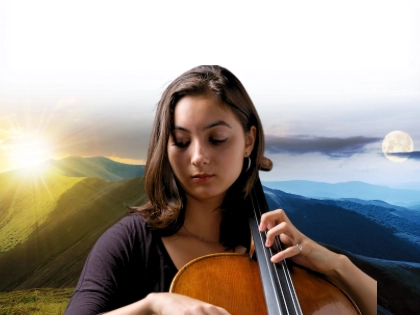
JOHNSON CITY, TN – A beautifully curated program that journeys from serene beauty to stirring emotional intensity, featuring three distinctive works. This concert pairs beloved orchestral and choral works with the exceptional artistry of our concerto competition winner. Audiences will experience the orchestra’s versatility, from the tranquil glow of Grieg’s sunrise to the radiant choral harmonies of Lauridsen, culminating in the emotional power of Schumann’s 2nd concerto, a performance that highlights both the enduring beauty of the classical tradition and the exciting promise of emerging talent.
Program:
Peer Gynt, Op. 23: Morning Mood……………………. …Edvard Grieg (1843-1907)
Cello Concerto in A minor, op. 129………………….Robert Schumann (1810-1856)
- Nicht zu schnell (Not too fast)
- II.Langsam (Slow)
- III.Sehr lebhaft (Very lively)
Lux Aeterna……………………………………………..…..Morten Lauridsen (b.1943)
- Introitus – Requiem aeternam dona eis.
- II.In Te Domine, Speravi
- III.O Nata Lux
- IV.Veni, Sancte Spiritus
- V.Agnus Dei – Lux Aeterna
In 1874, the Norwegian playwright Henrick Ibsen (1828-1906) invited his fellow countryman, Edvard Grieg, to compose incidental music for his 5-act verse play Peer Gynt which tells the story of the disastrous adventures of Peer Gynt, an arrogant and somewhat lazy youth who leaves his home to seek his fortune. Grieg ended up writing 26 short pieces of music that were integrated into the play. Today you will hear the introduction to Act IV: “Morning Mood.” This well-known little piece (it is only about four minutes long) seems to conjure up the Norwegian countryside with burbling fjords and twittering birds. The opening melody is passed between various woodwind instruments as the music builds to an early climax (about a quarter of the way through the piece), often said to represent the sunrise, before a gently turbulent section establishes itself. This turbulence is gradually overtaken by the original theme which softly concludes the work. Were you to listen to this music in the context of Ibsen’s play, you would find it linking back to the Norwegian mountain setting of Act III where Gynt had walked out on his lover, but it would also emphasize the contrast when the curtain rises for Act IV on a Moroccan landscape where we find Gynt trying to operate various scams to earn his fortune.
It is not widely known that in his childhood, Robert Schumann took cello lessons. This perhaps explains his affinity for the instrument. Interestingly, his cello concerto, completed in 1850, was never performed in his lifetime and suffered from poor reviews until listeners and performers alike realized this work was not designed to be a flashy showpiece, but rather displays a serenity and majestic surety in its beautifully crafted three movements which flow seamlessly one into the other.
In his composition, Schumann was particularly concerned with structure and coherence, and this is particularly evident in the first movement of the concerto where the cello part seems almost like a skilled orator engaged in conversation. Schumann abandons the long orchestral introduction so common in concertos and after a brief orchestral greeting, the cello enters with a lyrical, expressive melody that soon becomes impassioned and calmer by turn. In the spirit of a true conversation, the orchestra then contributes its own opinion. This alternation of soloist and orchestra, each developing the musical ideas continues until, just as in the best discussions, the original material returns but now it is informed by the previous discussion.
The short, slow movement proceeds seamlessly from the first, as the speed (tempo) becomes slower and the string players stop using their bows and pluck the strings in an effect known as pizzicato. This creates a lovely light accompaniment to the song-like lines in the solo cello. If you listen carefully you might even notice that at times the soloist is playing two notes at once, something possible on members of the violin family of instruments. Toward the end of this movement the music becomes more impassioned, and the speed gradually increases to transition to the final movements – a sprightly section in which the orchestra and soloist toss a variety of musical motives back and forth. If some of these motives (melodic fragments) seem familiar to you, you would be correct. Schumann has masterfully crafted his melodic material in order to create an intricate web of musical cross-references!
American composer, Morten Lauridsen combines the modern with the old in his 5-movement work for choir and orchestra titled Lux Aeterna (Eternal Light). Each of the five movements uses sacred Latin texts that mention light while the music makes subtle reference to Renaissance musical traditions yet maintaining a contemporary sound. Just as in Schumann’s concerto, the movements in Lauridsen’s Lux Aeterna are played without a break. The outer movements frame the work with text from the Requiem Mass. The orchestral introduction begins softly, gradually building as if light is just streaming over the horizon before the choir enters singing of eternal peace. In this movement, Lauridsen harkens back to a musical technique from the Renaissance called “canon” which he uses on the words “et lux perpetua” (and perpetual light). Up to this point, the singers have largely been singing the same words at the same time, but here they stagger their words and music (just as you do when you sing a round) creating a musical image of a perpetual stream of many beams of light.
The text of the second movement is from the Te Deum — poetry in praise of God dating back to the Medieval period when it was sung at the end of the early morning service on Sundays and other special days. Lauridsen again references historical musical practices, this time pairing voice parts toward the middle of the movement so that instead of the four voice parts singing together, they are separated out into two pairs which alternate (on the words “fiat misericordia”). Listen carefully and you might hear the brass instruments intoning a slow melody beneath – this is the tune of the Lenten hymn “Herzliebster Jesu” (Ah Holy Jesus, how has thou offended) from the 1677 Nuremberg songbook.
Lauridsen provides a lovely contrast with the third movement for unaccompanied voices. Using text from a Latin hymn for the Transfiguration, the movement is cast as a peaceful modern motet (sacred choral work) and is followed by the exuberant fourth movement which takes its text from the Medieval service for Pentecost. The final movement returns to the music of the opening, creating a cyclical structure. This text is traditionally sung three times and here, the composer transforms the third statement, turning it into a joyous “Alleluia” which incorporates fragments of melodies from all the previous movements, until the music gently settles into a place of repose to complete Lauridsen’s exploration of light.
© Alison P. Deadman, March 2026
Voices of the Mountains (VOTM)
Voices of the Mountains (VOTM) is an auditioned regional chorus affiliated with Symphony of the Mountains. Formed in 2003 through the merger of Kingsport’s long-standing symphony chorus (est. 1958) and the Bristol Concert Choir. VOTM, under the direction of Steve Sensenig, is dedicated to presenting exceptional choral music throughout the region. The chorus performs annually with the Symphony for its December holiday concert and a major orchestral work each spring, in addition to independent performances each season. Its repertoire spans classical masterworks, gospel and spirituals, and contemporary selections. Notable performances include Verdi’s Requiem, Orff’s Carmina Burana, and Fauré’s Requiem, with select ensembles appearing at Carnegie Hall and in Europe.
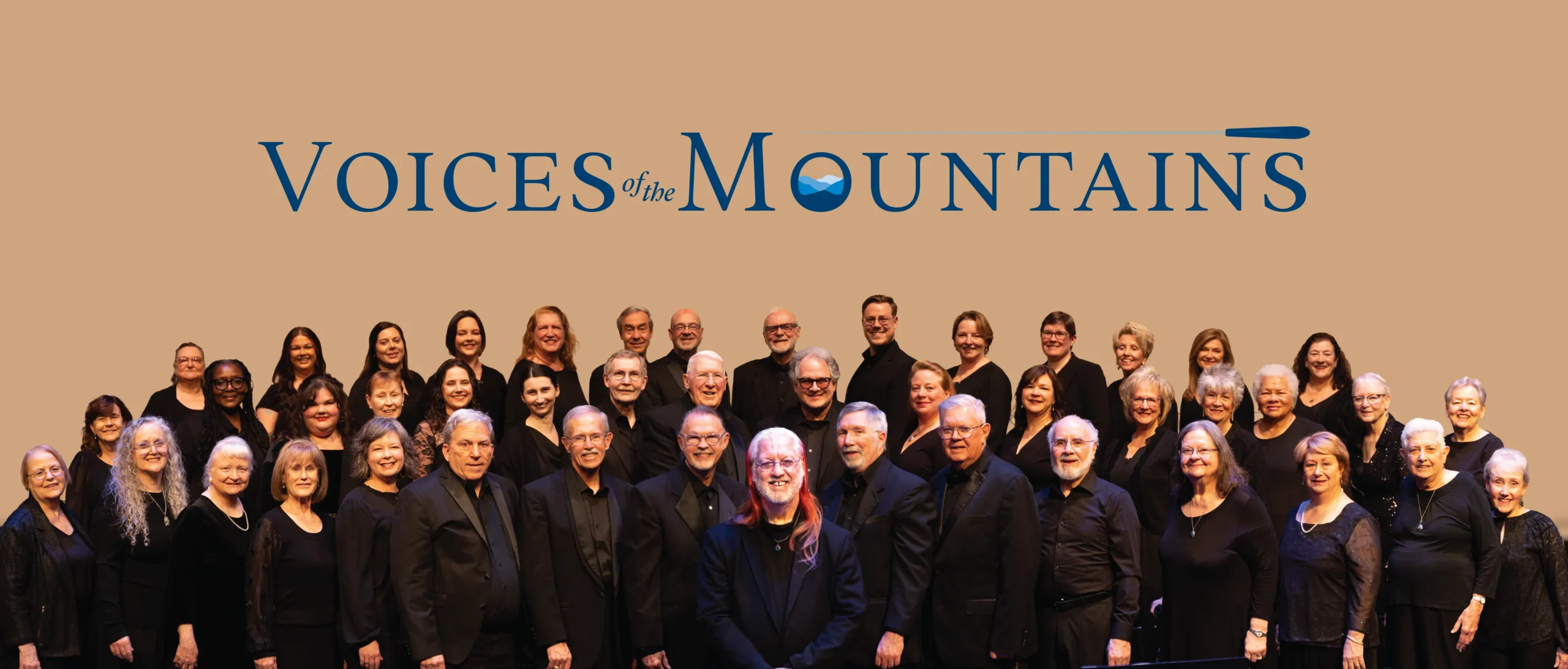
Voices of the Mountains Director
Steve Sensenig
Steve Sensenig is a passionate and versatile musician whose work spans the worlds of classical, jazz, pop, sacred, country, and film music. A prolific composer, arranger, and collaborative artist, he brings a unique blend of emotional depth and technical mastery to every performance and project.
Steve’s collaboration with Symphony of the Mountains began in 2011 when he served as Music Director for the joint Barter Theatre/SOTM production of Cabaret. He was later featured as piano soloist with the orchestra in several performances, most notably in Gershwin’s Rhapsody in Blue (2017). He officially joined SOTM as Principal Keyboardist in 2022 and became accompanist for Voices of the Mountains in January 2023. He is now honored to step into the role of Music Director and Conductor.
Formerly the Resident Musical Director of Barter Theatre, Steve has conducted and music directed university, church, community, theatrical, and cruise ship ensembles across the country and internationally. He currently serves on the music faculty of East Tennessee State University and King University, and is also a staff accompanist at Milligan University. He is also an accomplished film composer with multiple independent film credits and is currently scoring his first feature-length film. As an arranger, his work has been performed by internationally acclaimed artists including Liz Callaway, Judy Kuhn, Chloë Agnew, and Aaron Blake.
Voices of the Mountains Roster
2025-2026 Season
SOPRANO I
Marye Boggs
Samantha (Sam) Caywood
Cate Crawford
Jennifer Diamond
Rachael Ferguson
Whitley Grunstra
Lynetta Johnson
Kathryn Metcalf
Maggie Misterly
Melissa Nelson
Lisa Summar
SOPRANO II
Maureen Bibby
Lauren Blevins
Judy Fischer
Miranda Hartgrove
Martha Hawk
Jennifer Kennedy
Rachel Mehl
Susan Owens
Keri-Lynn Paulson
Florence Powell
Evelyn Pursley-Kopitzke
ALTO I
Tonni Carrigan
Phyllis Crabtree
Manda Fox
Kathi Horne
Gwen King
Sarah Kirk
Lana Luttrell
Michael Martin
Andrea Osborne
Anne Pratt-Proctor
Jeannie Sevigny
ALTO II
Carolyn Cox
Joan Denney
Sharon Franklin-Baker
Kristi Hall
Janet Haynes
Shelley Hubbell
Jennifer Krause
Leslie Mondul
Cheri Patterson
Deb Weddington
TENOR I
Parker Boggs
Randy Callahan
Robert Campbelle
Ericka Hernandez
Micah Mehl
TENOR II
Max Hanson
Rick Hawkins
David James
Michael New
BARITONE
Bill Bierschwale
John Gilmer
David Ginn
Roy Maine
Tony Martin
Jamie Osborne
BASS
Robert Banks
Todd Caywood
Robert (Bob) Greene, Jr.
Bill Haynes
Steve Patterson
Virginia Highlands Community College (VHCC) Concert Choir
The Virginia Highlands Community College Concert Choir is dedicated to musical excellence and community engagement. Under the direction of Ryan Whittington, PhD, the choir brings together talented student vocalists to perform a diverse range of choral repertoire. Known for its expressive sound and collaborative spirit, the ensemble provides meaningful performance opportunities while enriching the cultural landscape of the region through the power of choral music.
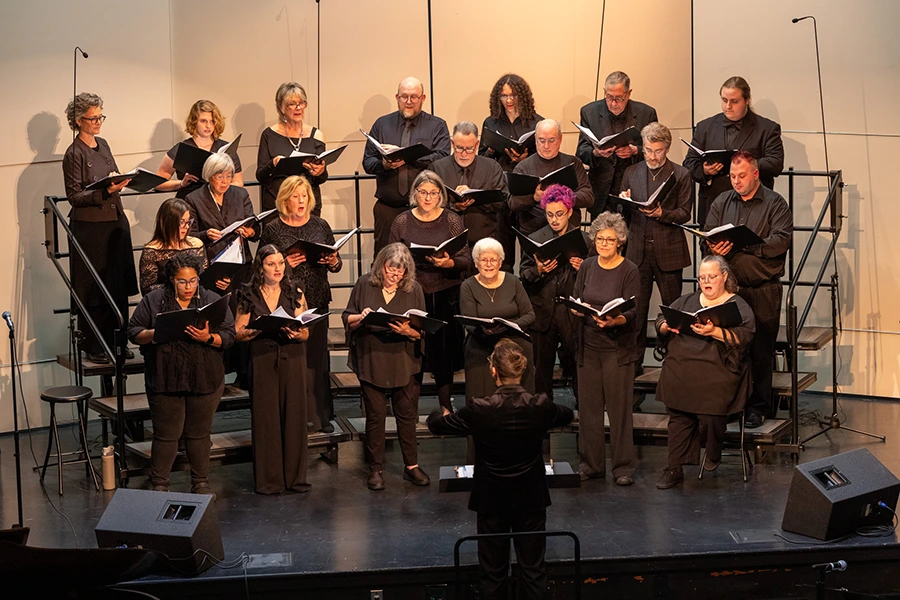
Virginia Highlands Community College Concert Choir Roster
Ryan D. Whittington, PhD, Director
Brandy Baxter, Accompanist
SOPRANO
Sandy Davis
Stephanie Devine
May Lam
Maria McBride
Katherine Nadeau
Kristie Sholtis
Susan Thomas
Joanna Wallace
ALTO
Daryl Ann Beeghley
Paige Brennon
Beatrice Denham
Aileen Duffy-Brown
Kelly Emery
Claire Lachniet
Laura Moore
Weeze Parker
Carol Raedy
TENOR
Steve Curd
Ryan Davis
David Linscott
Jim Sholtis
BASS
Landon Boyd
Dale Brooks
Noah Brown
Dave Carroll
CLICK HERE TO DOWNLOAD THE COMPLETE PRINTED PROGRAM
Tickets are $40 + additional venue fees. Students and Children receive free tickets courtesy of the Ty and Julann Warren Family Foundation.
Group discounts are available for this performance. A minimum purchase of 10 tickets is required. For group ticket sales, please contact the ETSU Martin Center Box Office at (423) 439-2787 Monday-Friday, 10:00 am – 2:00 pm, or by email Tickets@ETSUMartinCenter.org.
For accommodations for this performance, please contact our Box Office at (423) 439-2787 Monday – Friday, 10:00 am – 2:00 pm, or by email at Tickets@ETSUMartinCenter.org.